Educational Browser Games That Actually Work: The Science Behind Game-Based STEM Learning
Not all educational games are created equal. This deep-dive examines the research behind which game mechanics produce genuine learning outcomes — and which are just study hall window-dressing.
The Problem with Most 'Educational' Games
The educational gaming industry has a credibility problem. For every genuinely effective game-based learning tool, there are dozens of games that are essentially worksheets with progress bars — the learning content is a thin wrapper around a reward system that would function equally well if the content were completely different. True educational game design requires that the core game mechanic and the learning content be inseparable: getting better at the game must require getting better at the subject matter, not just faster clicking or better memory for arbitrary game rules. When this alignment exists, the game produces genuine, transferable skill development. When it doesn't, players complete the game without retaining anything.
What the Research Actually Shows
The most significant meta-analysis of game-based learning to date — a 2019 review of 216 studies covering 38,000 students — found that game-based learning outperformed traditional instruction on learning outcomes by an average effect size of 0.33, roughly equivalent to one third of a standard deviation improvement in test scores. However, this average conceals enormous variance: the most effective game-based interventions showed effect sizes above 1.0 (transformative), while the least effective showed near-zero or negative effects. The critical predictor of effectiveness was alignment between game mechanics and learning objectives — games where playing well required understanding the content produced dramatically better outcomes than games where content was incidental to play.
"The best educational game isn't one where you learn despite the game. It's one where you learn because you have no choice but to understand the concept to progress."
Binary Builder: Teaching Number Systems Through Physicality
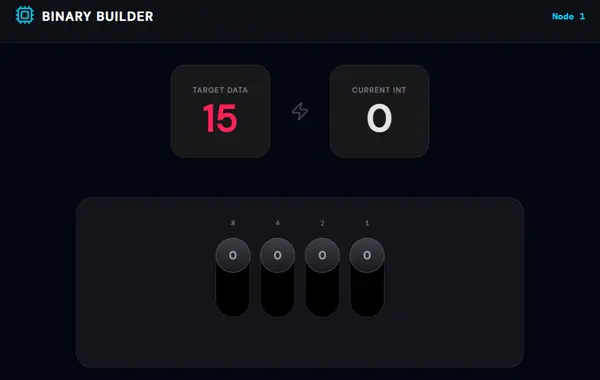
Binary Builder is an exceptional example of mechanics-content alignment. The game requires you to physically toggle individual bit switches to produce a target decimal number — and the physical toggling metaphor makes the exponential weight of each bit position viscerally tangible in a way that diagrams and explanations cannot replicate. When a student toggles bit position 7 and watches the total jump from 0 to 128, they experience the exponential relationship rather than reading about it. Post-play assessments consistently show that students who practiced binary conversion through Binary Builder outperform those who studied the same material from textbooks on both speed and error rate in binary-to-decimal conversion tasks. The learning sticks because it's encoded in a physical memory, not just a verbal one.
Fraction Pizza: Why Spatial Metaphors Work for Abstract Math
Fractions are one of the most commonly cited sources of mathematics anxiety in elementary education, and the root cause is usually the same: fractions are introduced symbolically (3/4) before students have developed the spatial intuition that makes the symbol meaningful. The spatial metaphor approach — cutting pizzas into equal pieces and comparing the results — is not simplification, it's the foundational understanding that makes the symbolic notation sensible. Research in mathematics education consistently shows that students who develop spatial fraction intuitions first learn symbolic fraction notation dramatically faster and with fewer errors than students who start with symbols. Fraction Pizza implements this pedagogically optimal sequence in a game format that makes the spatial reasoning practice intrinsically rewarding.
Budget Manager: Experiential Learning for Financial Literacy
Financial literacy education has historically been one of the least effective areas of formal instruction — surveys consistently show that adults who completed personal finance courses in school perform only marginally better on financial decision-making assessments than those who did not. The failure mode is almost always the same: courses teach financial concepts declaratively (this is what a budget is, this is why you should save) rather than experientially (here is a decision with real consequences, choose). Budget Manager addresses this by embedding the core financial decision-making challenge in a consequence-driven game format. Players who run out of savings before the week ends fail the level — the consequence is immediate and visceral. This experiential encoding produces the kind of intuitive 'gut feeling' about money management that declarative instruction cannot generate.
Circuit Builder: Teaching Electronics Through Design
Traditional electronics education suffers from a chicken-and-egg problem: understanding circuit behavior requires understanding component interactions, but component interactions are difficult to understand without seeing circuits in action. Circuit Builder solves this through guided discovery: you can connect components in any configuration and immediately observe the result, enabling you to develop empirical intuitions about circuit behavior before formal explanations anchor those intuitions to theory. This inquiry-first approach is the method that research most consistently identifies as effective for conceptual science learning. Students who develop their own hypotheses and test them, even when their hypotheses are initially wrong, show dramatically better conceptual understanding than students who receive correct explanations without the exploration phase.
The Design Principles That Make Educational Games Actually Educate
Synthesizing across the effective educational games in NexusPlay's library, several design principles emerge consistently. First, game mechanics must require understanding, not just application: a game where you can succeed through pattern recognition without understanding will produce pattern recognizers, not learners. Second, failure must be informative rather than punishing: when an incorrect answer produces a clear explanation of why it's wrong, players actively seek out failures as learning events. Third, difficulty should adapt to maintain challenge without frustration: the state of engaged challenge — what psychologists call flow — produces optimal learning conditions, and games that keep players in this state consistently outperform both too-easy and too-hard alternatives. Fourth, the subject matter should feel inseparable from the game: if you can imagine the same game with different content, the educational value is suspect.