The Complete Guide to Free Browser Card Games: From Solitaire to Poker
Everything you need to know about mastering the most popular online card games — strategy, history, and the hidden skill layers that separate casual players from consistent winners.
Why Card Games Have Survived for Centuries
Card games have been a cornerstone of human leisure for over 600 years, and their migration to browser environments hasn't diminished their appeal — it's amplified it. The reason for their endurance is that the best card games occupy a rare design space: they're simple enough to learn in minutes but complex enough to reward years of serious study. This combination creates a game that works for both a first-time player and a seasoned expert simultaneously, which is essentially impossible to replicate in any other medium. The standard 52-card deck functions as a shared language that billions of people already speak, allowing completely new game variants to feel immediately accessible.
Solitaire: The World's Most-Played Game
Klondike Solitaire's inclusion in Windows 3.0 in 1990 wasn't an accident of software bundling — it was a deliberate user experience decision. Microsoft's original goal was to teach users how to drag-and-drop with a mouse, and Solitaire was designed as the optimal learning vehicle: repetitive enough to build muscle memory, engaging enough to keep people practicing. The result was that Solitaire became the most-played computer game in history before online gaming even existed. Modern estimates suggest that between 35 and 50 million Solitaire games are played every day worldwide across digital platforms. Understanding why it works reveals a universal design principle: immediate feedback on every action, no waiting between decisions, and a clear visible goal state create optimal conditions for absorbed engagement.
"The best card games are easy to learn, difficult to master, and impossible to fully exhaust — that's why they've outlasted entire civilizations."
Blackjack: The Mathematics of the House Edge
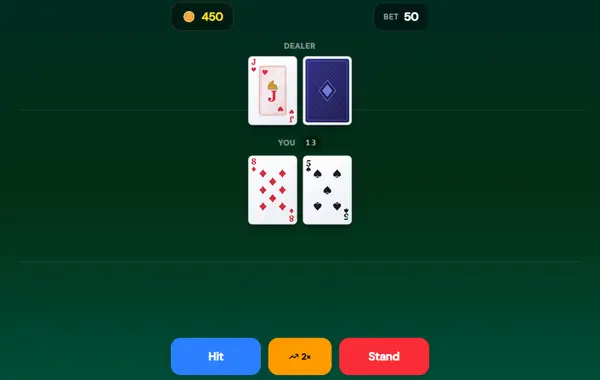
Blackjack is the only casino game where the player can mathematically reduce the house edge to under 0.5% through perfect basic strategy — a set of optimal hit/stand/double/split decisions for every possible hand combination against every possible dealer upcard. This strategy was first computed by computer simulation in the 1950s by a team of U.S. Army mathematicians and has been refined countless times since. The critical insight is that Blackjack decisions are not situational guesses — they are mathematical optimizations. Against a dealer showing 6, you never hit a hard 12 or higher, regardless of your intuition, because the probability math says the dealer will bust more often than you will if you draw. Free online Blackjack is genuinely the best place to learn and practice basic strategy because zero real stakes means you can focus entirely on decision correctness.
Texas Hold'em: Reading Beyond Your Cards
Texas Hold'em's global dominance as the premier poker variant comes from a specific innovation: the community cards shared by all players create a constantly evolving information landscape that rewards inferential thinking above raw card strength. The cards in your hand are almost secondary to the question of what your opponent's actions tell you about their hand. A player who raises before the flop, checks the flop, then bets large on the turn is communicating something specific about their hand and their confidence in it — reading that communication accurately is the primary skill that determines long-term results. This is why poker has a substantial professional class despite being a game with significant luck variance: in any single hand, luck dominates; across thousands of hands, skill determines everything.
Spider Solitaire: Why Four-Suit Is a Different Game
Spider Solitaire's one-suit variant and its four-suit variant share the same rules but are so different in difficulty that they're almost different games. In the one-suit version, any card can be placed on any higher card, which provides enormous flexibility and allows expert players to win nearly every deal. In the four-suit version, cards can only be placed on higher cards of the same suit — a constraint that dramatically limits your moves and requires carefully maintaining suit purity across all columns simultaneously. This four-suit constraint is what makes Spider Solitaire one of the deepest skill games in the solitaire family: you must plan not just the sequence of moves but the suit composition of each column throughout, treating the entire tableau as one large constraint-satisfaction puzzle.
Hearts: The Psychological Game Within the Game
Hearts is one of the rare card games where the optimal strategy actively conflicts with winning the most tricks — you want to avoid taking penalty cards, which means sometimes deliberately losing tricks you could win. This creates fascinating psychological dynamics: when a player attempts to 'shoot the moon' (taking all 26 penalty points to flip them to opponents), the other players must recognize the attempt quickly and actively sabotage it, overriding their normal avoidance strategy. The passing round at the start of each hand creates an additional layer of player modeling: what you pass reveals your hand's weaknesses, and experienced players use opponents' passes to deduce their strategy for the round. In Hearts, information management is as important as card management.
The Skill Floor vs. the Skill Ceiling
What distinguishes great card game design is the gap between the skill floor and the skill ceiling. A high skill floor means beginners struggle significantly; a low skill ceiling means experts reach mastery quickly and stop improving. The best card games have a low skill floor — anyone can participate from the first game — and an extraordinarily high skill ceiling — decades of serious play still reveal new dimensions. Poker exemplifies this perfectly: a complete beginner can play a full hand in 10 minutes, but professional players with 20 years of experience still disagree about optimal plays in specific situations. The games that remain engaging for a lifetime are those where the learning curve never fully flattens.